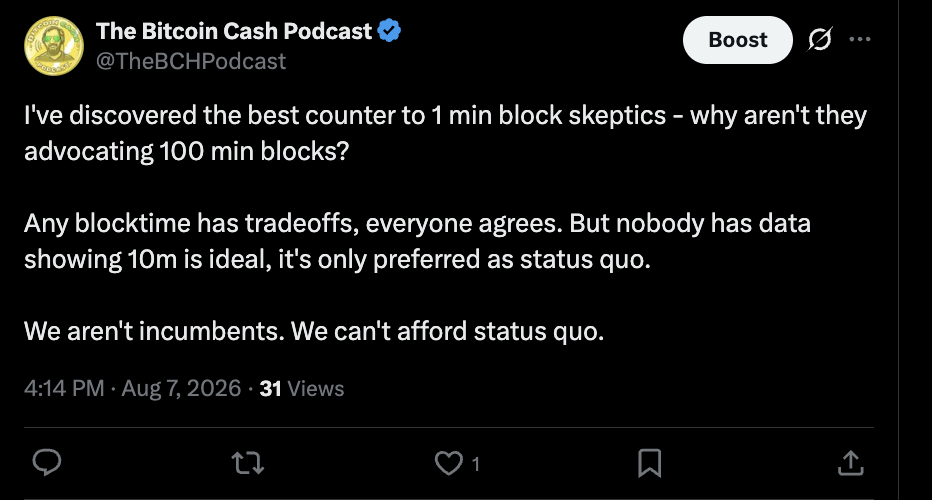
I object to this proposal because there is a fundamental trade-off that will make faster blocks harm SPV wallets.
To keep Bitcoin Cash a peer to peer electronic cash, we need to safe-guard the SPV wallet usecase, as that is the only known way to scale to billions of people, without introducing centralization and thus control. Lose the SPV usecase and 10 years from now we will hit scaling bottlenecks that become impossible to solve without sacrificing the decentralized nature of the coin.
An SPV wallet without central servers uses a simple concept, it downloads filtered blocks from a full node. Filtering a block implies the wallet sends a filter to the full node in order to allow the filtering to happen on the ‘server’. To not use server side filtering implies the wallet needing more bandwidth and CPU as the blocksize grows, and is thus not viable long term. Server side filtering is it.
A filter will essentially be a list of all addresses, but spending FROM an address should also work and spending FROM an address is not something a full node can do. As such the filter ALSO has a txid-outIndex combination.
So if I send a full node a filter that is viable at block 400, which then returns a transaction which deposits money in one of the addresses, I need to update the filter in order to see the transaction that spends that same money again in block 401. Lucky for us, the server will do this updating for us. So we can just batch block requests.
But there are still trade-offs, if you send 50000 requests because your imported wallet is that far behind, it won’t work. The node that is your server will see you as a DOS attack because a cheap request forces that node to be occupied for a while. Even if you can test this with a (patched) full node in private, it will fundamentally be a DOS attack and thus a real-life healthy network will need to stop that. Which means that the trade-off is smaller requests and incremental handling of data. Full nodes want to serve data, but not just to one abuser. Standard network rate limits.
There are other reasons why you can’t just ask thousands of blocks based on one filter too. For instance the filter is intentionally fuzzy. Which means you get matches that are not actually for you. This fact together with the server self-modifying the filter (see a couple of paragraphs back) will means more and more false positives.
Next to that, with a properly setup privacy wallet you want to avoid reusing addresses. As such a filter you send will get out of date too as it progresses in block-time. There are unlimited number of addresses on a HD wallet, which is great for privacy, but you can’t send a filter for all of them. Practically that won’t fit, but similarly it will mean that your wallet is not being very private.
The trade-off here is also, smaller batches work better.
When you ask for a single block, then the next block-filter will change a little based on the result of the first block. Transactions found that can be spent. Addresses used that can be removed from the filter. Addresses need to be added to not miss transactions.
The filter needs to constantly be adjusted. While you could just make the server do all that, which is largely what fulcrum allows, this is basically giving up on the concept of privacy.
So to repeat the base requirement of peer to peer money, no central servers, this means the filter concept as explained above is the only solution we have.
Latency
The fundamental requirement for private SPV wallets is thus inherently linear. As transactions come in the filter may need to be uploaded again. And if you already asked for 1000 blocks, and figure out at block 50 that that filter needs changing, then that will simply not be processed by the server until it finished those 1000 blocks.
What you need is bi-directional communication. You process the results of a block and decide if the server needs a new filter or not.
But this means you inherently add latency to the protocol. You can’t act on a (filtered) block until it arrived.
My Experience
The p2p network is filled with nodes where some are very slow (maybe some Pi with slow storage) and some are nice and fast. Similarly we have some that have low ping and some have high ping. And naturally the mobile network has extreme gradients in reliability and connectivity. So it is very hard to give numbers. And laboratory tests are very likely optimistic.
Tests I did gave about 100 blocks per second in 2025/2026.
This comes from code and logic written by me which is the result of learning and understanding the trade-offs I wrote in the long part above.
Can it be made faster?
Yes, but you’ll ask the server for more duplicate blocks at best, or get blocked at worst.
You may also just go with a very small number of addresses and reuse those which will similarly make things faster.
So the honest question is this:
Can SPV be made faster without sacrificing the peer to peer nature of our coin?
Answer is: Not by much.
Why then object to the proposal?
Because the fundamental problem is the speed of light, how long it take to ask a full node a question and the answer getting back to you. And that can’t be changed or innovated to be improved any time soon.
Making the block time shorter makes the sync similarly slower than today, on a fundamental level. It will basically make SPV too slow to be usable.
Which will lead the majority of people to prefer centralized solutions and that will kill decentralized peer to peer cash because eventually those centralized solutions will start to censor or worse.