
Hypothetical discussion: CHIP frequency & scheduling

Disclaimer: Some people immediately get defensive, panicked or triggered by merely the suggestion of changing the CHIP process (or anything in BCH). To be totally clear:

  1. These are just ideas, discussed hypothetically. Nobody is proposing to make any changes to the CHIP process (yet).

  2. If a CHIP is eventually proposed, it will be thoroughly iterated and vetted and could only activate by following the existing tried-and-true CHIP process as normal.

  3. The CHIP process is working very nicely at the moment. Nobody wants to disrupt that. But, circumstances can & will change. The CHIP process that works well today may not be suitable or ideal for future conditions. For example, as the community grows in size it’s likely the number of CHIPs being concurrently researched & proposed will increase (perhaps very substantially so) and this could materially strain the existing system (in a variety of ways). It’s also going to take longer for ideas to filter through a growing community, longer for them to be debated/iterated and longer to gain support. There is an inevitable and natural trend to osssification, and that as it may be, it’s still important for the BCH community to pre-empt and delay that inevitable fact as long as we possibly can.

  4. The status quo is comfortable and great, but as always, a change with demonstrated sufficient benefit, support and low enough risk is worth making in the interests of incremental improvement.

  5. It’s also possible we currently have a totally perfect system which needs no changes. But if we do, discussing and confirming that cannot hurt.

Ok that said, I’d like to have a thread to discuss the frequency and schedule for CHIP upgrades. This concept of a CHIP process review and increased frequency was actually raised by @mainnet_pat on the latest episode (195) of The BCH Podcast. I found this an intriguing concept, with lots of factors & potential. Obviously I’ve also suggested the idea of tweaking the CHIP schedule to only Saturdays, which a lot of people found immediately objectionable even just as a hypothetical idea - this isn’t the same idea but it kinda fits in the same category. Once again, I’m simply raising it for discussion.

Some thoughts:

  • The current annual schedule is partially a result of valuable experience & iteration (it was 6 months under BCH ABC, and that was a mixed bag), but also partially a result of simple inertia & habit. It works, but that doesn’t make it optimal. Slowing down was a great change in 2021 at the time of a fractured, contentious, low-trust community. But the situation is different now, with a proven & working process & lots of positive momentum, good faith discussion & successful collaboration.

  • 1 MB is not a fixed & optimal amount of blocksize, the pre-Velma VM Limits were not fixed & optimal limits, 10 minutes is not a fixed & optimal blocktime - 1 year is not necessarily a fixed & optimal upgrade schedule.

  • A simple concept is changing the frequency, faster OR slower. 3 months, 6 months, 18 months (TM, haha), 2 years, 5 years. What are the pros/cons of those options? The extremes of a daily upgrade or a per-decade upgrade seem ridiculous, but there’s a large spectrum between to consider. In fact, it’s not even required to have a regular schedule at all. Of course, that would be a radical departure from how we currently operate I’m simply raising it as a thought experiment - if the CHIP process can be used to reach a decision on a given CHIP it could also be used to set an ad-hoc activation date PER CHIP. This would create a lot of chaos if you assume nothing else is adjusted, so it doesn’t seem intuitively appealing. But I mention it here to accurately describe the options. Perhaps in a system with hundreds of developers working on a large number of CHIPs it would actually be optimal to schedule a stage in the CHIP discussion where an activation date was picked individually & locked in CHIPs would “sleep” in the code for multiple years until their activation date (so a rolling system where some minimum cadence of upgrades by stakeholders would always ensure code was running well in advance). That’s just one idea, it’s possible somebody can think of another clever way to build a rolling pipeline. There are pros/cons to that idea - it could be very fluid and flexible, but of course it sacrifices consistency, defined opportunities to celebrate and so on.

  • Particularly in the case of faster upgrades, creating more lock-in slots does not mean they would all need to have CHIPs actually lock-in. If we had half-yearly upgrades, we could skip slots where no compelling upgrades were ready - we might even still end up doing an upgrade yearly - but the fact of having more slots available would change the social dynamic on its own (the option to delay by just 6 months for increased consensus may be more appealing in borderline cases where 1 year feels too slow but immediate lock in feels too fast).

  • There is strength in simplicity. So our existing system is good for that. But that isn’t the end of the discussion, perhaps a system could have an alternating cadence of major/minor upgrades (which is more complicated, raises questions about how you decide etc. but might allow more speed without overly disrupting stakeholders). Maybe people have other ideas of what kind of schedule we could have.

  • It’s also possible an increased schedule could be only for chipnet(s) or testnet(s) but they also activate on mainnet in one annual upgrade.

  • Obviously all CHIPs have a research element, social element, a technical implementation element and a rollout element. These overlap, and the scheduling would play into all of it. So that needs to be factored into our thinking.

Ok those are just some ideas and concepts for people to play around with, putting it here for people to discuss as they see fit.

2 Likes

For that to happen, the CHIP owner & contributors have to farm attention. Even if the CHIP’s content is the perfect everything, it won’t automatically get through to activation. How will everyone else learn that truth? They need to give it attention. And nothing is perfect on the 1st take, so it is a very interactive and iterative process, and someone has to keep driving it to the finish line.

It’s all about attention, attention is the scarce resource, attention is the bottleneck, and even the current cadence is a challenge, so please don’t try make it faster. It may even naturally slow down.

I didn’t even manage to get OP_SIGHASH done (which is a low-hanging fruit IMO) because 1-min blocks took so much attention. We had a few other CHIPs too, why didn’t they progress?

IMO the cadence works good, and the 2 Schelling points work good, too. I think the challenge to squeezing more into each cycle is the “meta” cost and attention farming, for which owners have to be very proactive rather than expect things to move by themselves.

The current schedule has a lot going for it.

I think that part is underrated. The annual upgrade doubles as a public event, and that is good for morale, and worth protecting. Whatever we do, the mainnet activation (the existing Schelling points) should stay the party.

I’d formalise exactly that, as a release-engineering layer under the CHIP process:

  1. The CHIP is researched and drafted (the process as-is).
  2. The author proposes a test plan with pre-registered goals and metrics: network health plus the CHIP’s own acceptance criteria.
  3. A staging network is stood up for that CHIP (a separate candidate network, not a chain fork of chipnet), on its own or shared with compatible CHIPs, and runs for a fixed soak window, say 4 months.
  4. If the metrics hold, the branch is promoted into the release candidate for the next mainnet upgrade.
  5. If they don’t, the author keeps iterating with no deadline, and the process repeats until the code is ready for production. Nothing is lost and nobody waits: the other candidates keep moving.

One net can serve several compatible CHIPs at once. Think of it as a release train: one set of nodes, listeners and dashboards carries a batch of CHIPs through the same soak window. The infrastructure is shared, the volunteers are shared, and so is the attention. Incompatible CHIPs still get their own lane, but the common case is a shared candidate net with a common test plan and a common baseline of network-health metrics.

So: branch → automated tests (CI) → staging → release, with the mainnet activation as the deployment. Multiple lanes, one annual party. No change to CHIP governance or the cadence.

On this:

I agree, and none of the above is a proposal to make the cadence faster. A pipeline doesn’t create attention. Nothing does. What it can do is stop wasting it on the meta: an objection becomes a metric instead of a long thread, and a CHIP that isn’t ready waits in a branch without a deadline instead of competing for the annual slot. OP_SIGHASH is the real cost: a low-hanging fruit starved by the big CHIP. The fix isn’t more slots; it’s that when someone does pick it up, the path from “code ready” to “tested” is short and boring. If the same few people are the bottleneck, no process fixes that, but theirs is the attention we should spend on code, not on re-litigating.

I’d make “vetted” mechanical. Fixed in writing before the test starts:

  • (a) the CHIP’s own acceptance criteria: what must be true for this change to be considered correct;
  • (b) network health: stale/orphan rate, reorg depth and frequency, block-interval distribution, propagation (first-seen vs header), mempool behaviour, hashrate distribution;
  • (c) who signs off: the node code maintainers, with a named owner for the test plan. They review and say “pass” or “not yet”; they don’t have to write the implementation.

Pre-registered, not post-hoc. Fix the metric and the threshold before you look at the data, so the result can’t be rationalised afterwards. If you pick the yardstick once you’ve seen the numbers, you can always find one that “passes”. That is the difference between a test and a vibe.

One more thing on (c): if the CHIP sponsors and authors write the implementation, the maintainers move from writing it to reviewing it. That is still real work, but it is a much smaller load than asking maintainers to do the implementation themselves. Authors own the code; maintainers own the review. That is the trade-off: more work for the CHIP’s promoters, less for the node maintainers.

The staging net also gives the CHIP’s detractors something better than an argument: a way to prove the flaw with facts. If you think a proposal breaks something, take the branch, run it on your own candidate net, and show the failure with metrics. And a failure doesn’t kill the CHIP. It sends it back to step 5: fix it, or accept it is not ready, and iterate. That is the point: the process becomes less political and more engineering.

On the obvious objection, staging nets need hardware, and not everyone can afford it: I’d argue that’s the feature, not the bug. A candidate net is cheap; the tempnet ran on a Raspberry Pi and a handful of listeners, not a datacenter. Running a peer is the participation signal: if enough people care about a CHIP they show up to run it, and if nobody shows up that’s useful information about demand before we spend the annual slot on it. It also scales the right way: one interested volunteer can bootstrap the net, others join as peers. AI agents make this cheaper still, not as consensus participants (they can’t vote), but as load and usage simulators: mempool pressure, wallet patterns, adversarial traffic, the boring real-world stuff that a handful of humans won’t produce in four months.

We kind of have a working prototype already: the tempnet for the 1-minute-blocks CHIP. We could generalise that into a standard operating procedure.

I mentioned all this specifically in my post. The current system is working well at our current volume - but it’s likely going to need adjusting at significantly increased volume. Perhaps faster “slots” (to spread out the load) would be better, perhaps slower to give everything more cook time for attention by default.

The attention bottleneck you’re describing here is dev/implementer attention. The community at large also has an attention bottleneck, but we’re currently underutilising that. Implementers need sufficient attention to hit critical mass on ONE specific CHIP at a time, but the community has a very very high bandwidth (by distribution), but it also needs a longer exposure window to be convinced (for the same reason). So we want to get as many ideas circulating over long windows as we can for the community side, while implementers benefit from being sequential.

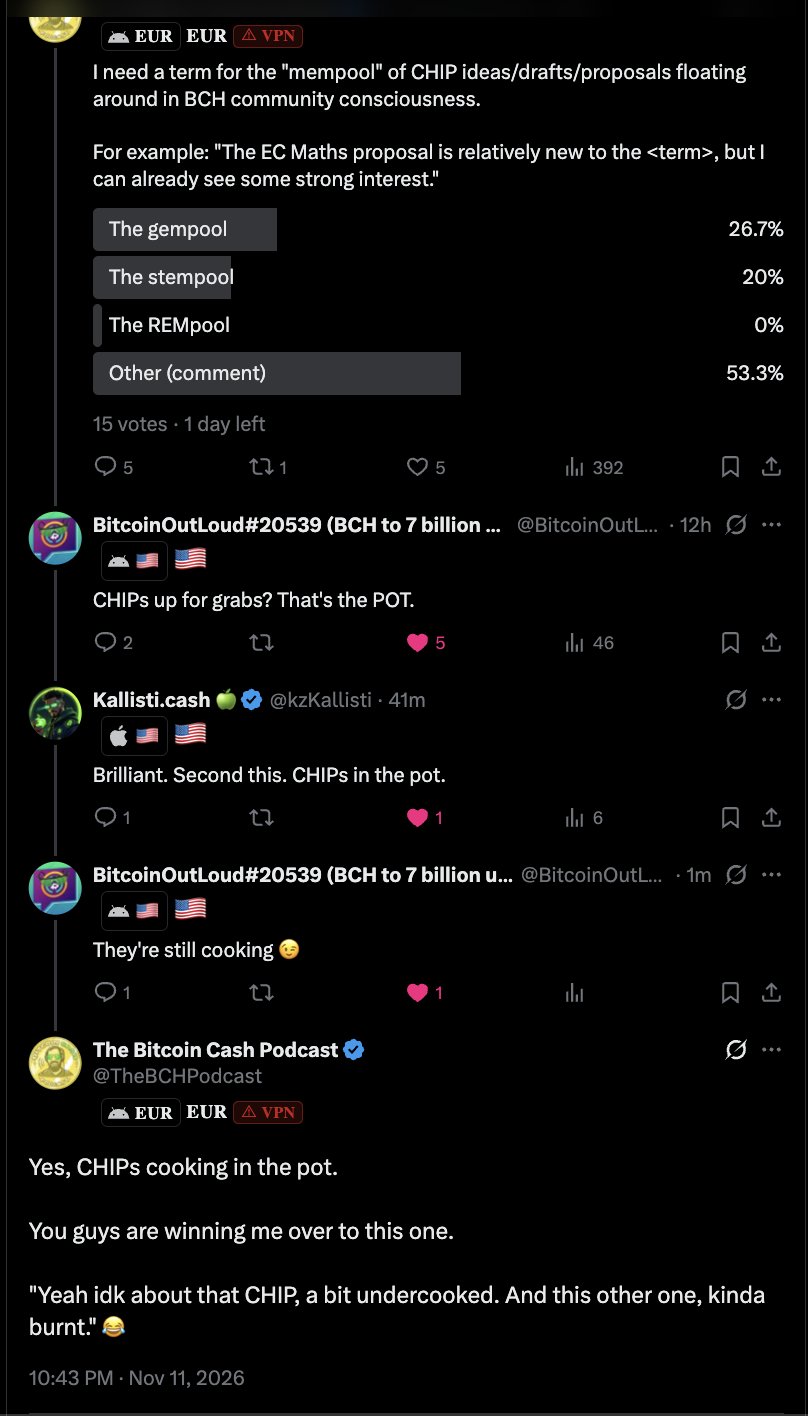
The community could easily be “considering” 5 or 10 CHIPs concurrently, but would need each CHIP to be “in the mempool” (the gempool? Stempool? :laughing:) for 3+ years. A CHIP author can produce a strong convincing large-change CHIP in 1 year of dedicated work, but probably not 2 CHIPs. The community can easily consider 2 CHIPs though, but again, not 2 CHIPs (or even 1) in only a single year timeframe.

I agree strongly, ironically I find it SO important that I think the CHIP process could even be adjusted to lean into this. However, when I suggested that with Saturday CHIPs, many people immediately got emotional & upset due to status quo bias before they really sat with the idea. Seems to me maybe the immediately obvious benefit wasn’t high enough to justify the cost at that time, but as the community grows & people increasingly anticipate and get excited about BLISS or other celebrations that it will start to click to people what the point of that is.

Yes, I like your ideas here a lot. Having a smoother process for CHIPs to run in pre-release parallel could make our bandwidth for discussion much higher (at the community level).

Exactly.

This is a great idea. Makes sense that we can find ways to let people be involved in spinning up and testing proposal test nets with higher visibility so they can demonstrate support. This already happens somewhat (with 1 minute blocks more than it ever has), but it is low visibility and pretty obscure to get involved in. ANd we can change that.

Exactly.

Please don’t let AI make up “formalized” processes or requirements for no good reason. This only creates burden. We don’t need to monitor “network health” for every damn CHIP. Most past CHIPs didn’t affect network parameters at all, so what’s the point of it? Testing for testing sake? Just use good judgement on a case-by-case basis, a too rigid process is an obstacle, not a help. What is the purpose of a test? You test when you don’t understand something. If everything is already understood – additional tests are vacuous and a burden.

“Always question the requirements.” – Elon Musk

Carrying a CHIP is hard enough as it is, we don’t need to make it even harder by turning a wishlist into requirements. What’s the goal? What problem are we solving here?

Sorry but this again smells like AI hallucination. Staging needs people, someone has to bear the burden of producing software and coordinating that it’s ran. People are the bottleneck. Hardware is the easy part, and RPi can process mainnet blocks, even 256MB scalenet blocks. Who brought “datacenters” into this conversation? FFS

For something to be cooked, someone has to maintain the heat. EC maths and SIGHASH weren’t cooked because their respective owners stopped producing heat. CHIP just siting there without attention is not being cooked, it’s cooling down.

Not even that, the implementer actually implemented it before 1-min blocks, because it was so easy: Implement: CHIP-2026-06: OP_SIGHASH (!2119) · Merge requests · Bitcoin Cash Node / Bitcoin Cash Node · GitLab

So here the CHIP owner himself (me) did not have the bandwidth to keep the heat on the CHIP, and I just let it cool down and intend to pick it up for next cycle. It’s not a failure of the process – it’s the process working as intended. No driver – no driving.

Many times I got upset about Nov 15th “deadline” because it created stress for me (with abla, with bigint, and now with fablous). I was afraid of missing the window, etc. But then, it motivated me and others to actually deliver on time, and so we did. It’s a kind of a test: do people care enough about this CHIP to pull through and meet the deadline? Now that the stress is off, I’m happy to defend both Schelling points :slight_smile: May 15th is easy to remember, I don’t have to look up the calendar. Everyone knows that everyone knows that we upgrade on May 15th and “lock-in” on Nov 15th. There’s value in preserving that, and every successful cycle only adds weight to preserving that.

1 Like

I agree the fixed dates tap into psychology to accelerate delivery. At the same time a CHIP is still judged by readiness and technical soundness in both implementation and concept.

However, if a CHIP is judged ready one or two months after the November lock in, forcing a full year wait makes little sense when it already has consensus and is technically sound. That just creates an unnecessary attention burden. I think even you felt some of that pressure around the fabulous upgrade. The process around dates does not need to be fully rigid and should allow limited exceptions when something is clearly ready.

A CHIP also does not need a single owner. It can work more like a published paper with multiple authors and a team. That scales better since people have different strengths. Open source already lets many contribute (coordination, PRs, taking it to the finishing line, etc.) without being formal owners, and a stalled CHIP can still be revived by someone else who drives it forward. In the end it is both a culture and a specific skill set. Some people like you simply have more experience with it. I think you should be a mentor for CHIPing :grin:

2 Likes

The cost of the CHIP process on the community is high and the risk of upgrading are always significant even if we have been lucky. Doubling the frequency doubles the cost and significantly increases the social risk from a potential consensus fork.

Many of the projects that required consensus changes have churned off or been abandoned, which is problematic for all the apps that depended on that software as well.

While I love to ridicule mindless “fork bad” propaganda, and I love highlighting all that we’ve gained through upgrades, I do agree with the reality that forking has significant costs and can be extremely bad if done poorly.

The semiannual upgrade schedule was something we tried from 2017-2020, and it was quite grueling.

Batching all proposed upgrades to a once a year event has yielded great results so far.

The BigInt and Bitwise CHIPs are great examples of leveraging small upgrades for huge results. The cadence of the existing process, and the ability to slip in on a “batch” process made them much cheaper to implement.

We can always make emergency upgrades when necessary. Our current process defaults to a multi-year upgrade if no meaningful upgrades are proposed for a year.

In short, if the upgrade process has been working great, we shouldn’t mess with it.

5 Likes

I think the community has gotten used to the 1 year cadence and its not worth changing. We can always bundle minor changes.

4 Likes

Good to see a variety of responses to this thread. Seems like people are mostly feeling good about 1 year cycle for the time being, and that’s a valuable if not entirely unexpected insight.

Best suggestion so far for the terminology of the concept of pending CHIPs is that they are in “the pot”.

I’m thinking to add a section to Consensus.cash that lets us keep an eye on circulating ideas. As the volume of those grows, and as it becomes more visible, I’m sure we’ll innovate on our process for running them all concurrently.

2 Likes

From the wallet side, the fixed yearly dates help a lot. Everyone knows upgrades land on May 15, so wallet teams can plan their updates ahead of time, and support teams know when to expect user questions.

The “pot” section sounds useful too. If wallet teams can see early which ideas might affect addresses, transactions or confirmation times, they can start preparing before lock-in instead of finding out at the last minute.

4 Likes

I am personally against any change to the CHIP schedule.

What I would be willing to consider:

  • Semi-annual (6-month) chipnet lock-in so that we could get stuff up on chipnet in May AND November.
  • No change whatsoever to the annual mainnet upgrade schedule; just one upgrade on May 15.

I think anything beyond this would create undue burden on the community at large, especially people who are not closely paying attention and only wake up once per year to upgrade their mainnet nodes.

Our objective is “global p2p electronic cash”/“global reserve currency”. We cannot understate what “global” scale means, and we should never adopt a “move fast and break things” philosophy when it comes to protocol changes.

I think one year is a sweet spot. 6 months is too fast, 24 months is way too slow. 18 months requires too much attention (is mainnet upgrade in November or May this year?)

So, I think a 2x 6 month cycle for chipnet COULD be beneficial - it would reduce some of the deadline pressure around the November 15 date. In an instance like this year’s faster blocks chip, it could have possibly given us an additional 6 months for the community to absorb the CHIP without bringing on the burden of maintaining attention for an entire additional year.

However, I overall do not find the current system to be broken. Had we not shipped an upgrade this year I don’t think it would have been the end of the world.

6 Likes

The distinction that matters is review cadence versus activation cadence. Keep mainnet activation on May 15 annually, but let CHIP review and chipnet checkpoints happen more continuously; that relieves deadline pressure without doubling consensus-fork risk. The “pot” page should show each idea’s stage and whether it needs wallet input, so wallet teams can filter early without treating every idea as a likely May change.

2 Likes

Welcome to BCH Research!

Interesting, this is the same suggestion @kzKallisti had that chipnet runs a little faster, giving more slots for ahead-of-time lock in and testing.

But also the idea of reaching out more proactively to wallet teams and infrastructure. That is a good thought.

Frequent updates do not necessarily attract genuine users; at this stage, the focus should remain on real-world adoption, actual usage, and the growth of on-chain TVL.

I believe that an annual upgrade—where research findings and thoroughly tested “Chips” are locked in and deployed—is quite sufficient. It provides enough visibility for all stakeholders to assess and follow the project’s progress; in my view, more frequent updates are unnecessary.

4 Likes