The real concern, and the inversion
The one serious point here is the perception of stability: money flees assets whose rules seem to change unpredictably. That concern is real, and the CHIP takes it seriously. The Risk Assessment section on Bitcoin Cash Image Risks exists precisely because of it.
But the inversion is this: the tick abstraction makes this the last time block time is a breaking change. Future adjustments become a parameter change. Append an entry to the tick schedule, and every time-sensitive rule follows. So the CHIP is the anti-instability move. It is a one-time change that buys long-term stability, the opposite of “rules constantly changing.”
And BCH’s annual upgrades are not “constantly changing rules” in the sense that scares money. They are scheduled, coordinated, and documented. Money flees unpredictable change, not change everyone knows is coming on a fixed calendar. The annual cadence is a feature, not a bug.
The two-speed model you are defending is the problem
You say BCH operates at two speeds: on-chain (slow) and 0-conf (fast), and the user has to adapt. You then hold up Bitcoin’s Lightning, Liquid, and custodial services as the same model. But that is exactly the failure mode the CHIP is trying to fix.
Bitcoin’s two-speed model exists because BTC cannot change its base layer. Users flee to L2s and custodians because on-chain is too slow and too expensive. That is ossification, not stability. BCH’s 0-conf plus on-chain is the same two-speed model, and the CHIP does not eliminate it. It makes the slow lane less slow: 10 to 40 minutes becomes 1 to 3 minutes, with far less variance.
And there is a hidden instability in the two-speed model you are defending: the fast lane can collapse into the slow lane at any moment, through no fault of the user. A 0-conf payment that hits a mempool desync, a risky transaction shape, or a service that suddenly demands a confirmation is instantly downgraded to the slow lane. You are never purely 0-conf; you are 0-conf until circumstances force you out of your lane. With 10-minute blocks, that forced exit means a 10-to-40-minute wait. With 1-minute blocks, it means 1 to 3. The two-speed model does not disappear; its failure mode just stops being brutal.
So if you are fine with the two-speed model, the CHIP is a strict improvement to it. The only way to object is to say the slow lane should stay slow, which is the ossification argument. That is the thing that turned Bitcoin into a chain where normal people cannot transact.
Fastcoin is a non sequitur
Fastcoin failed because it had no adoption, no ecosystem, no network effects. Not because 12-second blocks are bad. The relevant precedents are chains that changed block time while already having users: Monero (1 to 2 minutes), Zcash (150s to 75s, now voting 75s to 25s), Dogecoin (1 minute from launch). Those are the controlled experiments. Fastcoin is a new coin with no users; BCH is an established chain changing a parameter. The two are not comparable.
And nobody claims speed alone makes a coin succeed. The CHIP claims speed is one improvement among many. “If it were just about speed, Fastcoin would have succeeded” is a strawman.
Dogecoin, LTC, and XMR were cited for viability, not success
Those coins were cited for one narrow purpose: proving that shorter block times work operationally. Not that they make a coin succeed.
“Dogecoin only exists because of Elon Musk” is false. It ran for seven years before Musk’s 2021 involvement, with 1-minute blocks the whole time. And it is irrelevant. The operational fact stands regardless of who tweets about it.
“LTC and XMR are niche” is wrong on both counts. Litecoin changed nothing from Bitcoin except faster blocks and a different PoW algorithm, and it held the number one altcoin spot for years despite a structural price headwind: it started later, so it sits a few halvings behind BTC on inflation. Its entire value proposition was “Bitcoin, but faster blocks,” and the market rewarded exactly that.
XMR is not niche either. It sits around #12 at roughly 10B market cap, ahead of BCH, and its selling point is privacy, not speed. Yet even a privacy coin finds 2-minute blocks necessary; 10-minute blocks would be painful for it. And XMR’s block time history is the most instructive precedent in this whole debate: it launched in 2014 with 1-minute blocks, then moved to 2-minute blocks in 2016, when propagation tech was inferior and compact block relay was still being adopted elsewhere. Even under those conditions, with adoption growth to worry about, the “conservative” move was 2 minutes, not 5, and not 10. A decade later propagation is far better, and what was conservative then is 1 minute now.
Their block times prove the technical point. Market size is a separate question, and the CHIP addresses it elsewhere.
Your two user types omit the actual target
The model is fine as far as it goes: small-value users want speed, large-value users do not care about minutes. But it omits the population the CHIP actually targets, and it misreads who that population is.
First, the onboarding user on a multi-coin service. BitPay, Moonpay, Trust Wallet, Binance. They cannot use 0-conf because the service does not implement it, and they are forced to wait 10 to 40 minutes with high variance. “Small-value users use 0-conf” is true inside the BCH-native ecosystem, but false for the majority who onboard through multi-coin services.
Second, and more importantly: existing BCH users. Even inside our own ecosystem, 0-conf is not always available. A Cauldron user who hits a mempool desync, or any 0-conf payment that trips a risk signal, is instantly downgraded to a 1-conf wait through no fault of their own. The CHIP targets existing BCH users first: our own experience improves for every scenario where we cannot avoid a confirmation. And it has a chance of converting more users on top of that. Even if it only improved the lives of existing BCH users, it would be worth it.
“Large-value users do not care about minutes” is true and irrelevant. The CHIP is not for them. The CHIP is for everyone else: the onboarding user who waits 10 to 40 minutes today, and the existing user whose 0-conf lane just collapsed into the slow lane. That is not “a few minutes.”
“Won’t abandon for a few minutes” contradicts itself
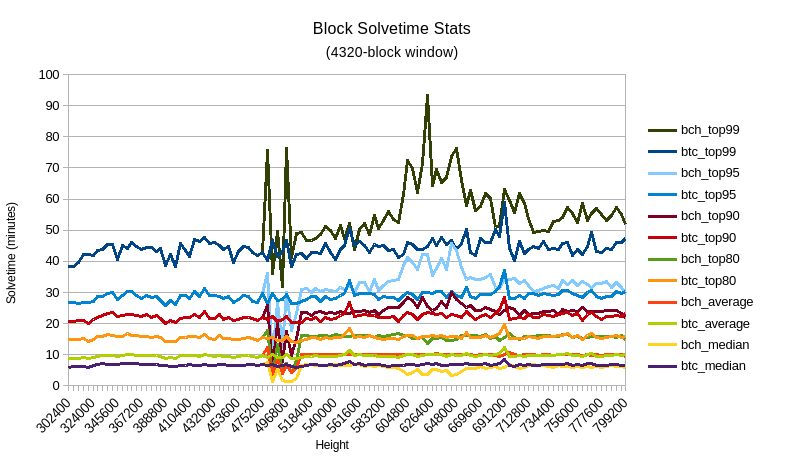
Three problems. First, for the target population the wait is not “a few minutes.” It is 10 to 40, with high variance: 25% over 14 minutes, about 14% over 20.
Second, as Jeremy put it above: not necessarily, but many will abandon, and many, many more will never join to begin with. The abandonment you can see is the small part; the onboarding you never see is the large part. Every user who would have tried BCH and bounced off a 30-minute first confirmation is invisible to you, but they are not invisible to the network’s growth.
Third, this contradicts your own fast-payment-user point. If minutes do not matter, the status quo is fine and the CHIP is harmless. If minutes do matter, the CHIP helps. You cannot have it both ways.
The honest version: minutes matter a lot for the onboarding user, and not at all for the large-value user. That is exactly why fine granularity is better than a coarse 10-minute quantum. It serves both.
The ETF point is a non sequitur
ETF investors hold through custodians. They do not care about block time at all. Bringing up the ETF actually supports your “large-value users do not care about minutes” point, which is irrelevant to the CHIP, because the CHIP is not for them.
Conviction is what evidence produces
Jeremy already landed the decisive blow here, and it is worth repeating. If conviction comes from higher block time, why not 100-minute blocks? 1,000-minute blocks? Why not? If conviction comes from ossification, are you advocating BCH never upgrades again, for maximum conviction?
If you are not advocating either, then conviction has nothing to do with block time. You have to acknowledge that.
And the meta-point is the real one: the way to acquire convinced users is to deliver the best product and to show that the project improves when the benefits are clear. Changing is a meta-benefit as well as a benefit. It shows we are not ossified, waiting to be outcompeted like BTC.
Conviction is not a thing you demand from users. It is a thing evidence produces. The CHIP is the evidence.
This post is a list of reasons to be cautious, and caution is fine. But caution is not an argument against the change. It is an argument for doing it carefully, which is what the CHIP is.