
I am at risk of filling the Sunlight thread with endless rambling of my research & theory, but I also want to continue developing my Starlight idea in public. The Sunlight thread & the Sunlight talk at BLISS are highly recommended foundational materials.
I think this could easily form the basis of a future CHIP, so I began drafting it today. As usual, a disclaimer that this is just ideas. No changes are being proposed. Just sit with it a while.
What I have so far is presented below (I will put it into a version controlled doc soon). More coming in future, this is all very very theoretical, but for now this is perhaps a clearer explanation or starting point to the concept of Starlight. Can’t hurt to have other smart minds thinking on it as well.
“~” is my symbol for “TBD”.
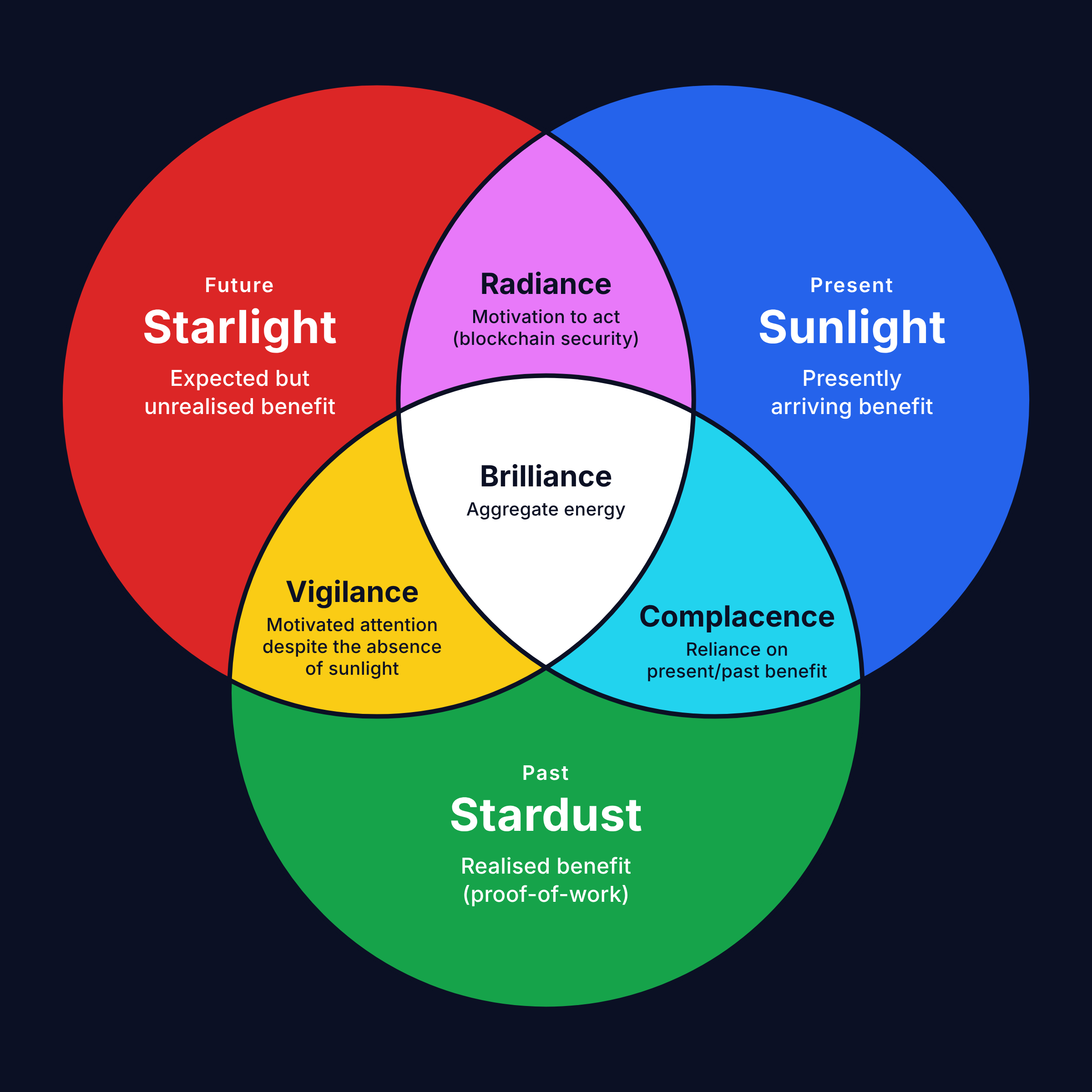
CHIP 2026-11 Starlight
Future-weighted consensus alignment.
“I’ll never let you go
If you promise not to fade away, never fade away.”
First, we introduce the theory of Brilliance to describe & measure blockchain energy. Second, we introduce the sub-categories of Brilliance (including Radiance) and investigate the specific importance of its component Starlight. Third, we apply this knowledge to propose a system which theoretically near-guarantees the ability for an honest-actor group to perpetually resist a hostile bad-actor majority, and practically improves Bitcoin Cash’s transaction processing-speed, resilience & market-value through incentive alignment enforced by cryptography.
Brilliance
Brilliance is a measure of aggregate energy (or value) associated with a blockchain. The name is a metaphor derived from the physical property of light - the higher energy, the more brilliant.
Just as minerals have a Mohs scale of hardness to compare & contrast them, blockchains have a “Brilliance scale”. The more Brilliant a blockchain, the more there is happening around & because of it - the “brighter it is shining”.
By its very nature, Brilliance is hard to objectively quantify or measure. It is subjective, ephemeral & constantly fluctuating. Anybody who acquires a cryptocurrency coin for any reason does so because they perceive some degree of Brilliance in it (otherwise they would refuse to accept it as payment and/or wouldn’t bother to mine it). Investors (including coinholders) are constantly trying to acquire coins on blockchains that are disproportionately Brilliant by looking for signs of rising energy & potential in an ecosystem that others have not spotted. This is true for all goods (which by Austrian economics are all potential monetary goods), and Brilliance could be considered for those cases, but here we restrict ourselves to its relevance in a cryptocurrency context.
Cryptocurrencies are often measured & ranked by marketcap. Brilliance includes the marketcap (higher marketcap is more Brilliant), but is broader & less measurable than that.
Consider any growth or improvement of a blockchain ecosystem which is outside of quantifiable, traded market activity.
- Example 1: A new developer chooses a particular blockchain & begins developing an application for it.
- Example 2: A bored youth hears about a particular blockchain in the media, grows fascinated with it and begins promoting it to his friends.
- Example 3: A cryptocurrency logo has been graffiti’d on a wall. Passing pedestrians consciously or subconsciously absorb the symbol as they pass it - gaining greater brand affinity & familiarity simply by passive exposure.
- Example 4: Time passes, thereby increasing the perceived resilience of a continuously existing blockchain via the Lindy effect.
Examples 1 & 2 are active accumulation of Brilliance to a blockchain by human action (although the individual involved is not necessarily aware of it), while examples 3 & 4 demonstrate a blockchain passively accumulating Brilliance without human action. None of these examples can be globally tracked or directly impact the market cap in the immediate term, but they contribute aggregate energy, value & blockchain ecosystem activity which “shines” throughout reality (and later may increases the market value).
Brilliance Subcategories
Brilliance comes in three distinct forms:
| Name | Temporal Nature | Definition | Example Blockchain Manifestation | Example Ecosystem Manifestation |
|---|---|---|---|---|
| Starlight | Future* | Acquired but unrealised Brilliance. | Frozen pre-maturity coinbase rewards. | Announcement of an ecosystem conference. |
| Sunlight | Present | Acquired & presently being realised Brilliance. | Valid transactions arriving to the mempool. | Livestream of an ecosystem conference while it is underway. |
| Stardust | Past | Acquired & realised Brilliance. | Valid, transaction-confirming proof-of-work chain headers. | Recorded livestream or edited VOD uploads of an ecosystem conference post conference completion. |
*Technically Starlight has already occurred, it is just in “transit” or “suspended animation”. But it’s conceptually easier to consider it “future”, which is how it will be referred to. This is the same way that light emitted from a distant star has already occurred at the location of the star, but it will only become visible in the future from the point of view of an observer on Earth. The value of an announced conference is in the expectation of the eventual conference occurring in the future, not in the announcement itself (which has already happened).
Brilliance = Stardust + Sunlight + Starlight.
Stardust & Human Motivation
Human motivation comes from present benefit or future unrealised benefit. Realised benefit is worthless in motivating ongoing action. Nobody continues to pay the plumber after the toilet has been unclogged. Thus, Stardust does not contribute to a blockchain’s security, while Sunlight & Starlight do. Stardust contributes to Brilliance, because it reinforces the credible prospects of Sunlight or Starlight (a lot of Stardust is the physical manifestation of previously captured Star/Sunlight), but it carries no energy itself (it is dust, not light).
A blockchain with years of accumulated proof-of-work embedded in its header chain (Stardust) is worthless to miners if no new transactions are arriving (Sunlight) and there is no credible prospect of transactions coming soon or emissions remaining in the protocol emission schedule (Starlight). Previously acquired coin emissions & transaction fees are not a motivation to continue expending energy on proof-of-work in the absence of protocol-promised emissions or mempool-held transaction fees. Likewise, a cryptocurrency podcast with hundreds of published episodes (Stardust) will not bother broadcasting a new episode (Sunlight) or planning future episodes (Starlight) if it seems no-one else would be interested in listening. The previously published episodes are not motivation to continue, only the prospect of future listeners.
Radiance & Blockchain Security
A secure blockchain is one with lots of Sunlight and Starlight. We will call this property Radiance.
Radiance = Sunlight + Starlight.
Brilliance = Stardust + Radiance.
A blockchain may be very Brilliant (lots of Stardust) but not Radiant (no Sunlight or Starlight). This is the precise concern of Bitcoiners worried about the “security budget”, that as coin emissions decrease the coin will become insecure if transaction fees do not rise to replace the incentive to continue, no matter its history of accumulated proof-of-work.
Although it is hard to measure precisely, the Radiance of a blockchain is equivalent to the global investment in the survival of the project (continuation of transaction processing). In other words, increasing Radiance signals investment & activity in a blockchain, potentially increasing its market value (recursively adding further Radiance). Decreasing Radiance does the opposite.
~ Because Radiance correlates to blockchain security, ~.
Categories
Starlight comes in three distinct categories:
- Inherent: Frozen coinbases.
- 1a: Coin emissions (inflation).
- 1b: Transaction fees.
-
Staked: Coins locked for future-release on-chain, but presently inaccessible (similar to frozen coinbases). Can come in the form of a protocol-defined rule (requiring a hard fork), or permissionlessly created with a DeFi covenant. Coins locked at Badgers.cash are a current example of staked Starlight. But in future, more advanced or deliberate forms of it could be developed.
-
Phantom: Any off-chain Starlight. This includes any long-running legal contracts & economic obligations for mining companies, such as (supplier-side) multi-year warehouse tenant agreements or (client-side) futures contracts to deliver mined Bitcoins at a fixed price.
Inherent Starlight
Note that transaction fees are awarded to a miner in the same coinbase transaction that carries emissions, which is a point of (accidental?) genius by Satoshi. Transaction fees contribute inherent Starlight, not just coin emissions. Just as transaction fees are expected to slowly replace the coin emissions in the coinbase as part of the security budget, a growing volume of transaction fees increases inherent Starlight.
~
Staked Starlight
~
Phantom Starlight
~