
Idea: Starlight

I am at risk of filling the Sunlight thread with endless rambling of my research & theory, but I also want to continue developing my Starlight idea in public. The Sunlight thread & the Sunlight talk at BLISS are highly recommended foundational materials.

I think this could easily form the basis of a future CHIP, so I began drafting it today. As usual, a disclaimer that this is just ideas. No changes are being proposed. Just sit with it a while.

What I have so far is presented below (I will put it into a version controlled doc soon). More coming in future, this is all very very theoretical, but for now this is perhaps a clearer explanation or starting point to the concept of Starlight. Can’t hurt to have other smart minds thinking on it as well.

“~” is my symbol for “TBD”.


BCA has brought it to my attention that so much theory should be able to be simplified to get the crux of the idea across.

The “as glib & overly-simplified as possible” 2 word explanation of Starlight is “Reverse PoS” (in the same way Elon’s Starship is “Big reusable rocket”). Once again, nobody freak out about an idea. It’s just an IDEA, and this is the most overly simplified and inaccurate way of saying it. Starlight does not require a permissioned set of validators, it does not replace PoW, I just got asked to boil the idea down to a 3-words-or-less phrase and that’s what it is.

The slightly longer but still very simplified idea is:

  • PoW is accumulating security from past blocks
  • Sunlight is accumulating security from present (mempool, mining share) block
  • Starlight is accumulating security from future blocks

or said differently:

  • PoS is where you bet your coins that your PAST blocks won’t be orphaned.
  • Starlight is where you bet your coins that your FUTURE, PoW blocks won’t be orphaned
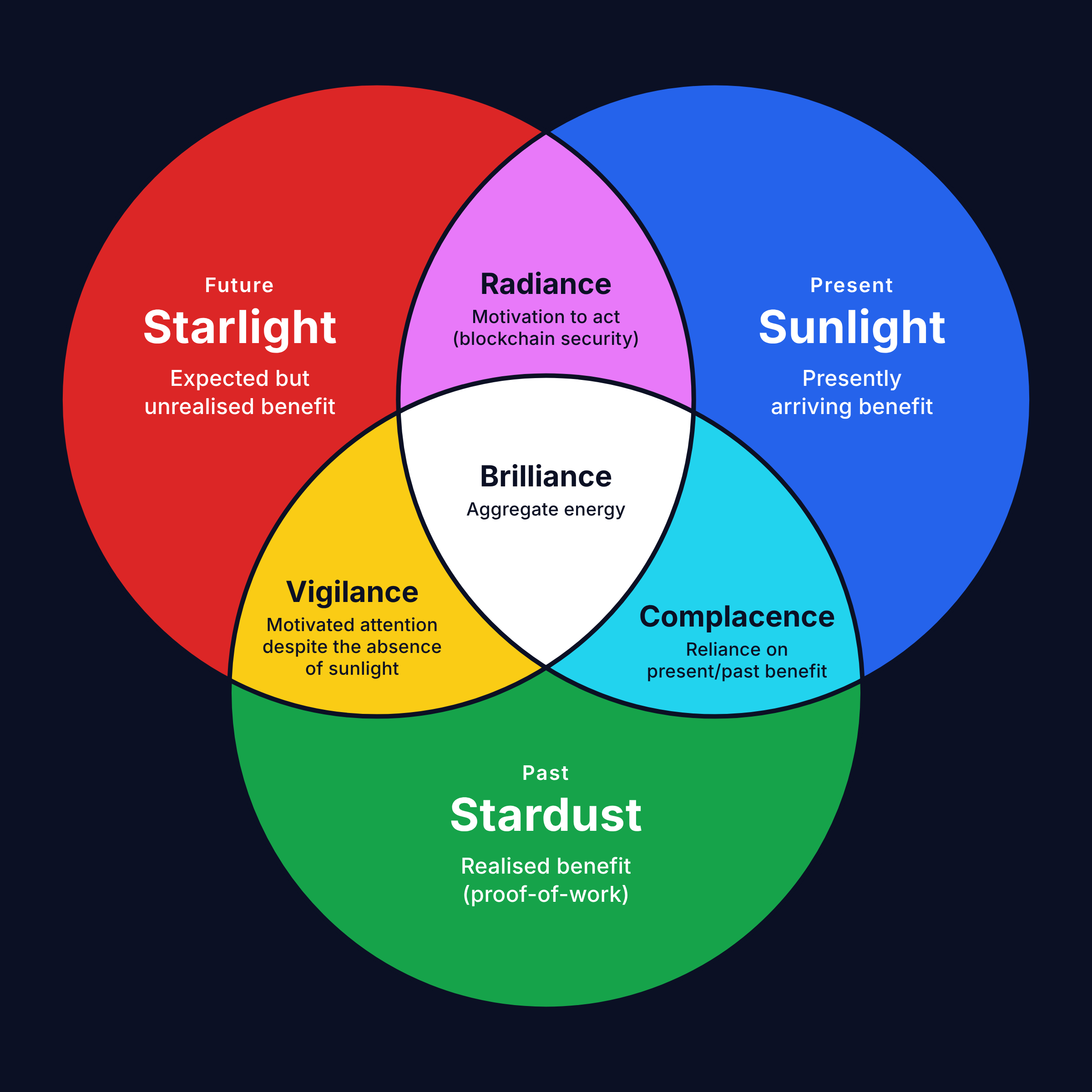
CHIP 2026-11 Starlight

Future-weighted consensus alignment.

“I’ll never let you go
If you promise not to fade away, never fade away.”

First, we introduce the theory of Brilliance to describe & measure blockchain energy. Second, we introduce the sub-categories of Brilliance (including Radiance) and investigate the specific importance of its component Starlight. Third, we apply this knowledge to propose a system which theoretically near-guarantees the ability for an honest-actor group to perpetually resist a hostile bad-actor majority, and practically improves Bitcoin Cash’s transaction processing-speed, resilience & market-value through incentive alignment enforced by cryptography.

Brilliance

Brilliance is a measure of aggregate energy (or value) associated with a blockchain. The name is a metaphor derived from the physical property of light - the higher energy, the more brilliant.

Just as minerals have a Mohs scale of hardness to compare & contrast them, blockchains have a “Brilliance scale”. The more Brilliant a blockchain, the more there is happening around & because of it - the “brighter it is shining”.

By its very nature, Brilliance is hard to objectively quantify or measure. It is subjective, ephemeral & constantly fluctuating. Anybody who acquires a cryptocurrency coin for any reason does so because they perceive some degree of Brilliance in it (otherwise they would refuse to accept it as payment and/or wouldn’t bother to mine it). Investors (including coinholders) are constantly trying to acquire coins on blockchains that are disproportionately Brilliant by looking for signs of rising energy & potential in an ecosystem that others have not spotted. This is true for all goods (which by Austrian economics are all potential monetary goods), and Brilliance could be considered for those cases, but here we restrict ourselves to its relevance in a cryptocurrency context.

Cryptocurrencies are often measured & ranked by marketcap. Brilliance includes the marketcap (higher marketcap is more Brilliant), but is broader & less measurable than that.

Consider any growth or improvement of a blockchain ecosystem which is outside of quantifiable, traded market activity.

  • Example 1: A new developer chooses a particular blockchain & begins developing an application for it.
  • Example 2: A bored youth hears about a particular blockchain in the media, grows fascinated with it and begins promoting it to his friends.
  • Example 3: A cryptocurrency logo has been graffiti’d on a wall. Passing pedestrians consciously or subconsciously absorb the symbol as they pass it - gaining greater brand affinity & familiarity simply by passive exposure.
  • Example 4: Time passes, thereby increasing the perceived resilience of a continuously existing blockchain via the Lindy effect.

Examples 1 & 2 are active accumulation of Brilliance to a blockchain by human action (although the individual involved is not necessarily aware of it), while examples 3 & 4 demonstrate a blockchain passively accumulating Brilliance without human action. None of these examples can be globally tracked or directly impact the market cap in the immediate term, but they contribute aggregate energy, value & blockchain ecosystem activity which “shines” throughout reality (and later may increases the market value).

Brilliance Subcategories

Brilliance comes in three distinct forms, which each have measureable/quantifiable/cryptographically verifiable on-chain manifestations & more abstract, less-quantifiable off-chain manifestations:

Name Temporal Nature Definition Example On-chain Manifestation Example Off-chain Manifestation
Starlight Future* Acquired but unrealised Brilliance. Frozen pre-maturity coinbase rewards. Announcement of an ecosystem conference.
Sunlight Present Acquired & presently being realised Brilliance. Valid transactions arriving to the mempool. Livestream of an ecosystem conference while it is underway.
Stardust Past Acquired & realised Brilliance. Valid, transaction-confirming proof-of-work chain headers. Recorded livestream or edited VOD uploads of an ecosystem conference post conference completion.

*Technically Starlight has already occurred, it is just in “transit” or “suspended animation”. But it’s conceptually easier to consider it “future”, which is how it will be referred to. This is the same way that light emitted from a distant star has already occurred at the location of the star, but it will only become visible in the future from the point of view of an observer on Earth. The value of an announced conference is in the expectation of the eventual conference occurring in the future, not in the announcement itself (which has already happened).

Brilliance = Stardust + Sunlight + Starlight.

Stardust & Human Motivation

Human motivation comes from present benefit or future unrealised benefit. Realised benefit is worthless in motivating ongoing action. Nobody continues to pay the plumber after the toilet has been unclogged. Thus, Stardust does not contribute to a blockchain’s security, while Sunlight & Starlight do. Stardust contributes to Brilliance, because it reinforces the credible prospects of Sunlight or Starlight (a lot of Stardust is the physical manifestation of previously captured Star/Sunlight), but it carries no energy itself (it is dust, not light).

A blockchain with years of accumulated proof-of-work embedded in its header chain (Stardust) is worthless to miners if no new transactions are arriving (Sunlight) and there is no credible prospect of transactions coming soon or emissions remaining in the protocol emission schedule (Starlight). Previously acquired coin emissions & transaction fees are not a motivation to continue expending energy on proof-of-work in the absence of protocol-promised emissions or mempool-held transaction fees. Likewise, a cryptocurrency podcast with hundreds of published episodes (Stardust) will not bother broadcasting a new episode (Sunlight) or planning future episodes (Starlight) if it seems no-one else would be interested in listening. The previously published episodes are not motivation to continue, only the prospect of future listeners.

Radiance & Blockchain Security

A secure blockchain is one with lots of Sunlight and Starlight. We will call this property Radiance.

Radiance = Sunlight + Starlight.
Brilliance = Stardust + Radiance.

A blockchain may be very Brilliant (lots of Stardust) but not Radiant (no Sunlight or Starlight). This is the precise concern of Bitcoiners worried about the “security budget”, that as coin emissions decrease the coin will become insecure if transaction fees do not rise to replace the incentive to continue, no matter its history of accumulated proof-of-work.

Although it is hard to measure precisely, the Radiance of a blockchain is equivalent to the global investment in the survival of the project (continuation of transaction processing). In other words, increasing Radiance signals investment & activity in a blockchain, potentially increasing its market value (recursively adding further Radiance). Decreasing Radiance does the opposite.

~ Because Radiance correlates to blockchain security, ~.

Categories

Starlight comes in three distinct categories:

  1. Inherent: Frozen coinbases.
  • 1a: Coin emissions (inflation).
  • 1b: Transaction fees.
  1. Staked: Coins locked for future-release on-chain, but presently inaccessible (similar to frozen coinbases). Can come in the form of a protocol-defined rule (requiring a hard fork), or permissionlessly created with a DeFi covenant. Coins locked at Badgers.cash are a current example of staked Starlight. But in future, more advanced or deliberate forms of it could be developed.

  2. Phantom: Any off-chain Starlight. This includes any long-running legal contracts & economic obligations for mining companies, such as (supplier-side) multi-year warehouse tenant agreements or (client-side) futures contracts to deliver mined Bitcoins at a fixed price.

Inherent Starlight

Note that transaction fees are awarded to a miner in the same coinbase transaction that carries emissions, which is a point of (accidental?) genius by Satoshi. Transaction fees contribute inherent Starlight, not just coin emissions. Just as transaction fees are expected to slowly replace the coin emissions in the coinbase as part of the security budget, a growing volume of transaction fees increases inherent Starlight.

~

Staked Starlight

~

Phantom Starlight

~

You’re starting from the wrong end, a marketing draft. You’re selling a non-existent solution. Do the work to actually try specify the mechanisms, prove to yourself first whether they actually work out or not. That should come before coming up with fancy names for things.

Sunlight was under-specified, but I tried filling the gaps myself when I evaluated it as an alternative, and I really only had to prove that it’s not in conflict with 1-min blocks. Sunlight sounds like it could work in principle, but also sounds like too complicated to actually implement and get going (the increased P2P chatter and set reconciliation of various piles/templates), and for what gain?

Starlight not even coherently defined, so can’t even evaluate it on technical merit, and it sounds even more complicated, and for what gain would we need it? Are you after the holy grail of instant preconsensus?

3 Likes

The useful next step is to define Starlight as a fork-choice rule, not a narrative: given candidate tips and a starlight score, what exactly do honest miners and validators select, and what happens if the score is disputed, unavailable, or Sybil-inflated? That would let readers compare it with Sunlight and 1-minute blocks on liveness and reorg resistance. If the answer is ‘preconsensus,’ then say so and specify the safety assumption under a hostile majority; if not, the claimed speed and resilience gain needs a concrete mechanism.

1 Like

Fed past conversations to DS4.1 and produced a summary for easier reference


The Sunlight thread

(link)

It opens as an attempt by bitcoincashautist to verify his understanding of Jack’s BLISS talk, called “Just a Bunch of Blocks,” before writing an “Evaluation of Alternatives” section in the faster-blocks CHIP.

The idea as presented. Nodes forward only the first tip they see, so the network is blind for most of a block interval: no view of competing tips, hash distribution, or double spends. Sunlight publishes what miners already produce and discard, in three layers — relay all blocks including competing and shorter tips; broadcast work-only weak shares (header plus PoW, no transactions) so the winning tip is visible in seconds; broadcast templates (the tx lists being mined) so mempool state and transaction conflicts become visible. Shares are unordered: they are weight on a template, not links in a chain, so they cannot fracture consensus the way sub-minute blocks would. Ordering still comes only from full blocks.

The central correction. im_uname pushed back that “reward publishing, punish hiding” must be formalized as a consensus rule, not a norm, and that framing Sunlight as mere reorg resistance undersells it. The OP folded this in: a tip that wins the block race while carrying far less visible share-weight than its competitor can be rejected or parked, so the share-weighted tip wins rather than the longest one. That reframing became the thread’s backbone — including the claim that no information-only version works.

The pairing with 600s → 60s blocks. Most benefits run Sunlight → faster blocks: faster convergence after a race (orphan aftermath, not orphan rate), continuously accumulating visible PoW on a public tip so 1-conf risk decays rather than stepping down at the next block, template pre-propagation reducing the missing-tx propagation stall, and “punish hiding” mattering more because withholding a block costs ten times less at 60s. The one benefit running the other way is memory coupling, and after BitcoinCashPodcast caught the error it was corrected from linear to quadratic: outstanding share state scales as TPS × block_interval² / share_interval, so a 600s block implies roughly 100× the state of a 60s block at fixed share interval (600 × 32 MB versus 60 × 3.2 MB). This is the argument that 60s blocks make the share layer implementable at all.

Implementation honesty. Block relay is synchronous with validation behind cs_main, and one missing transaction stalls propagation. Work-only shares are easy and off the critical path; templates are the hard part but attack the stall at its source. Hence a two-phase roadmap.

The fault lines. tula_s mounted the strongest critique: the “consensus versus just information” framing is dangerous because “consensus” here is weakly subjective, not absolute like an opcode rule — everything is valid, some things merely more valid, and what you lock onto depends on what you saw first. On that reading “can reject” is not “must reject,” and the claim that no information-only version works is overstated; he listed three levels (info-only, commitment not to misbehave, commitment to punish) and warned the framing could poison discourse like the hard/soft fork vocabulary did. The OP largely conceded, first that information-only still buys DoS-resistant template sync, and more broadly that the live tip has no absolutes. Attribution notes followed: ShadowOfHarbringer observed this resembles his Infrastructure Blocks, tula_s that it resembles 15-year-old weak blocks, and the OP credited a 2016 TierNolan bitcointalk post making the same near-miss argument. BitcoinCashPodcast contributed a Quai PoEM comparison, and Anzus_GemWallet repeatedly asked for plain-language merchant framing that never quite arrived.

Where it turned into Starlight. In post #18 BitcoinCashPodcast asked whether increased orphan chance is punishment enough, then proposed slashing: miners commit to a coinbase address in their templates, and a proven template lie forfeits the reward, with the slashed funds paid to the prover as a monitoring bounty. He named it Starlight, extended it to staking existing coins in a covenant, and reached “instant transactions on BCH solved.” Post #21 reframed frozen coinbase as an already-existing Starlight pool — 99 × 3.125 ≈ 309 BCH ≈ $64.7k, or $17M if CBM were raised to BLAKE2B’s 180 days.

The Telegram chat

(link)

This is Jeremy/BitcoinCashPodcast and bitcoincashautist working out the concept live.

Jeremy’s framing: PoW accumulates security from past blocks, Sunlight from present ones, Starlight from future ones. He called it “reverse PoS” — PoS bets coins that past blocks won’t be orphaned; Starlight bets that future blocks won’t be. He stressed that frozen coinbase is value in suspended animation, that it only pays if the chain survives, and that volunteering to be slashed is a hard-to-fake signal of good acting, with the analytical cost of capital and off-chain hedging as reasons miners may not mind longer lockups.

bitcoincashautist’s objections: frozen is not slashable; slashing the future payment is effectively slashing work already spent; it smells like PoS; you cannot identify who published a template, since a miner can use a different coinbase address or a large miner can false-flag another; and above all, making it work would require permissioned mining or introduce censorship vectors. He closed with “feels like Avalanche v2, bolting on a whole new consensus system, to gain what exactly — we didn’t even work out if Sunlight can work.”

The substantive exchange. Jeremy replied that the proof need only be enforced on the good chain, and that a committed honest minority can refuse to follow a bad-actor majority regardless of hash ratio — citing BCH splitting from BTC. He argued the predicate is simply “published a template containing X, then mined a block containing conflicting Y,” which honest template churn never triggers. He defended the 2× bounty claim (attacker loses $1 and a competitor gains $1) and the reverse-PoS label. bitcoincashautist's strongest line was that “the pow happened at the same time in all 3 scenarios” — the variation is attribution, not time.

Big Hair’s question — could a miner sell locked future PoW to another miner — drew an enthusiastic yes and a link to hedging via BCH Bull.

Where it all stands

Two mechanisms have been proposed, and the review found both with the same shape of defect: a real problem, closed by a mechanism that is opt-in or fixed rather than universal and scaling, and that in the only configuration where it is enforceable is redundant with what Sunlight already does.

  • Starlight’s predicate needs a determinate author, a determinate violator, and adjudication, none of which PoW supplies. “The good chain will enforce it” is hash exclusion by identity, which is a permissioned set defined socially — and a 1%-hash chain is low-revenue and defection-prone.
  • The bounty makes framing a bonded miner profitable at roughly two block rewards, since a coinbase address is not an authorship proof.
  • Locked coinbase is a prize, not a pledge; long CBM likely lowers hashrate by taxing working capital, and the $17M is gross locked value, not value at risk.
  • Hiding and selective feeding — the attacks that most need deterrence — leave no provable lie.

The surviving residue is the cheap, no-protocol-change version: verifiable collateral disclosure as a reputation and counterparty-selection signal, plus the observation that miners are the hedge side of BCH Bull and that off-chain commitments are under-researched. The dedicated Starlight thread then restated the claim as a taxonomy (Brilliance, Radiance, Stardust, Phantom), which bitcoincashautist answered with “you’re starting from the wrong end, a marketing draft.” The open research questions, if anyone picks this up, are the proof predicate and identity binding without permissioning, the griefing price, the equilibrium behaviour of a minority coalition, and whether any of it predicts something falsifiable — Sunlight’s own P2P cost and state-reconciliation burden first among them.

You can build a rocket starting from pen & paper physics, or starting from scrap metal. You prefer the metal approach, but I prefer the pen & paper.

I’m doing things in the right order for me. And that starts from the theory. We all have different ways of working, so I’m just requesting that you take it on faith based on my previous track record if you have to that this is an idea worth thinking about while I flesh things out. I’m working as fast as I can, but I’m busy and it’s not something I can just blast out of an AI in 5 minutes, by definition it is all very novel work.

You will notice that many of my ideas start with cool names and branding, and then develop into solid engineering effort & impact. See also: Selene, BLISS, BLAZE…

The gain is explained in the very start

Yes, it’s somewhat similar to instant pre-consensus in its effect (and somewhat in its implementation, but less so). I know you’re concerned about reinventing Avalanche and adding permissioned elements - but it is not that. It only requires PoW, our existing scriptability, and public key cryptography to own coins.

Don’t get too held up on the instant transactions part though. That is a significant benefit (I believe), but the real gold is in giving BCH credible & lasting resistance to hashrate attacks by even an overwhelming majority of the hashrate (in theory, we’ll see how impactful it is in practice. Impact will be above 0, but I also can’t promise we’ll be perfectly fine if all of the BTC hashrate came to attack us tomorrow. More research required).

Again, I understand it’s just theory for the moment, but please do sit with it a bit before dismissing it out of hand. I promise more development of the idea is coming - first more of the theory, then the more practical elements.

I’m putting it out there now ahead of time in the spirit of working in public & because this is something that will take people a while to get their head around regardless.

Yes, I will do some more work in this area definitely. It won’t be the very next thing, but I agree with what you’re saying and I will have this kind of research at some point.

1 Like

One other point worth making to anyone reading this thread.

The reason there’s a lot of theory & new vocabulary being introduced is because new ideas/ways of thinking require new labels.

Before DeFi was invented, there was not words/phrases/acronyms like DeFi, NFT, AMM, DEX, yield farming and MEV. Those things had to be named because otherwise there was no way to talk about this new stuff.

That’s the same thing that is happening here. I believe that in future people across the cryptocurrency industry (and perhaps even beyond) will commonly talk about & reflect on “Starlight”, “Sunlight”, “Stardust”, “Radiance” & the rest… but it will take a while for the concepts to become proven in practice, then popular, making the lingo spread to carry it to new curious minds.

Maybe it looks like marketing babble from an engineering point of view, but what I’m trying to do is not create buzzwords but explicate concepts people aren’t used to talking about and don’t have words for. You can “Replace all” “Starlight” → “X” and “Sunlight” → “Y” and read my writing that way if you want. The words are just containers for (novel) ideas, albeit they are carefully chosen to fit the coherent overall physical metaphor that makes the ideas themselves easier to understand.