
We're getting very close to a Killer app only thing missing is putting everything together

I’ll go straight to the point. The first app/wallet that can offer a simple way to exchange fiat currencies with a straightforward UI, coupled with a good enough on/off-ramp for users, could take a big chunk of the remittances market. We’re talking Billions

What that “app” needs:

  1. A behind-the-scenes DEX to handle the fiat-to-CashTokens swap. For example, different users could sell their MUSD in exchange for €, while others buy that MUSD using their target fiat currency.
  2. Fiat on-ramp: This is the part that has me scratching my head the most. It’s the most important because it’s the one that will actually move value onto the chain. If we mess this one up, that’s it—game over. Minimizing friction is key, but the payment market is very fragmented, so catering to every single option isn’t realistic. Compromises will have to be made to target particular markets.
  3. Off-ramp: Not as important. I know it sounds counter-intuitive, but hear me out. Once your money is locked in the app, the user will figure out a way to use it—especially if we’re talking about the recipient (who actually spends the money) getting it from a family member in another country.
    In areas with significant merchant adoption—like Buenos Aires or the Philippines—this could get the ball rolling much faster.

Why I think we’re ready for an app like this:

All of this you can already do; it’s just that no one has put it all together in one seamless solution.

  • You can buy BCH with your credit card on the Coinbase app or in the Bitcoin.com wallet.
  • You can swap CashTokens on a number of sites (e.g., DEXes like Cauldron).
  • You can sell your BCH on many CEXs and get fiat deposited to your bank account or whatever local payment processor is popular/hyped.

Unifying these three things is the killer app, for mass adoption in my opinion.

Let’s put an example: Imagine Argentinians working in Europe. Every month, they send a few hundred € home. Current options include Western Union, Remitly, etc.—those are relatively straightforward but expensive, not only due to commissions but also because they don’t always offer the best exchange rate. A more advanced user might have an account on a CEX like Coinbase or Binance, buy crypto there, and then swap it for pesos on a local exchange. That involves using ~2 or 3 different platforms, and the savings aren’t always huge—maybe they lose 2% in the process. This person would switch to a better alternative in a heartbeat. So, if they could just open an app, type in an amount in €, send it across the Atlantic for less than 1% total cost, and the recipient has a good enough way to spend it… that’s game over. Extra points if, after the first transaction, the rest are one-click simple—like Amazon’s checkout.This would incentivize merchants to figure out how to interact with end users who now have cash in their pocket. Merchant POS software becomes the ideal off-ramp, and once word spreads, more merchants would jump in.

ATMs could be a nice off-ramp too, but that requires more hardware—though I’m sure there are off-the-shelf solutions that are easy to set up. But deploying hardware is expensive and that cost goes back to the user defeating the point.

I’d love to hear your thoughts. Do you think a collaboration between some of the projects can pull this off?

2 Likes

This has been already done, based on my ZKAM-FMT design.

A company called “ZKP2P” (they changed name recently) created a working fiat onramp that can work with minimum involvement of the bank.

They borked it though - designed it differently, because my original design provides a way to create a fiat onramp that works for money transfers with zero involvement of the bank (meaning, the bank cannot stop it easily).

Meaning: Zero KYC/AML.

ZKP2P is called “peer” now. Here is their current website:

Latest version of my ZKAM-FMT design is available here in PDF format. But the BCHR discussion might be also worth reading.

1 Like

PUSD and MUSD are token derivatives that wrap swap positions tied to oracles that are driven by markets controlled by USDT/USDC and other “official” licensed stable coins.

If users want to transact in dollar tokens, they don’t need any kind of bitcoin, or contracts, or tokens wrapping swap positions, or oracles.

Banks will build lots of “killer apps” for them.


The irony of these “Killer” bank apps, is that a lot of folks have begun to ask if retail banking is necessary. If someone provides a mechanism to track and score users for the purposes of issuing credit, in an app, would retail banks need to exist? is perhaps the fuller version of that question.

1 Like

That’s the closest I’ve ever seen to what I had in mind. The UI is very polished. Still I think it has too many options for an app dedicated to remittances, and it makes sense because looks like the focus is more in buying into crypto.
Anyway very Impressive. I’ve been playing with it and is difficult to get really low fees the best is like 1% which is not bad but i think using BCH it can be possible to go below 1% consistently. Specially if there is enough adoption that the recipient can use the app to pay.

1 Like

Exactly something like this would be a stopgap to hedge against volatility, the only real hurdle left for BCH to overcame. and to survive a transition period where the banks will loose some of their market.

Once an area has a big enough network of merchants, the customers income is in BCH and volatility is gone there’s no need for an app like this.

It would be only a tool to help with adoption. Other argument for the people doing the leg work in the streets to convince the merchants to run a Bitcoin Cash POS.

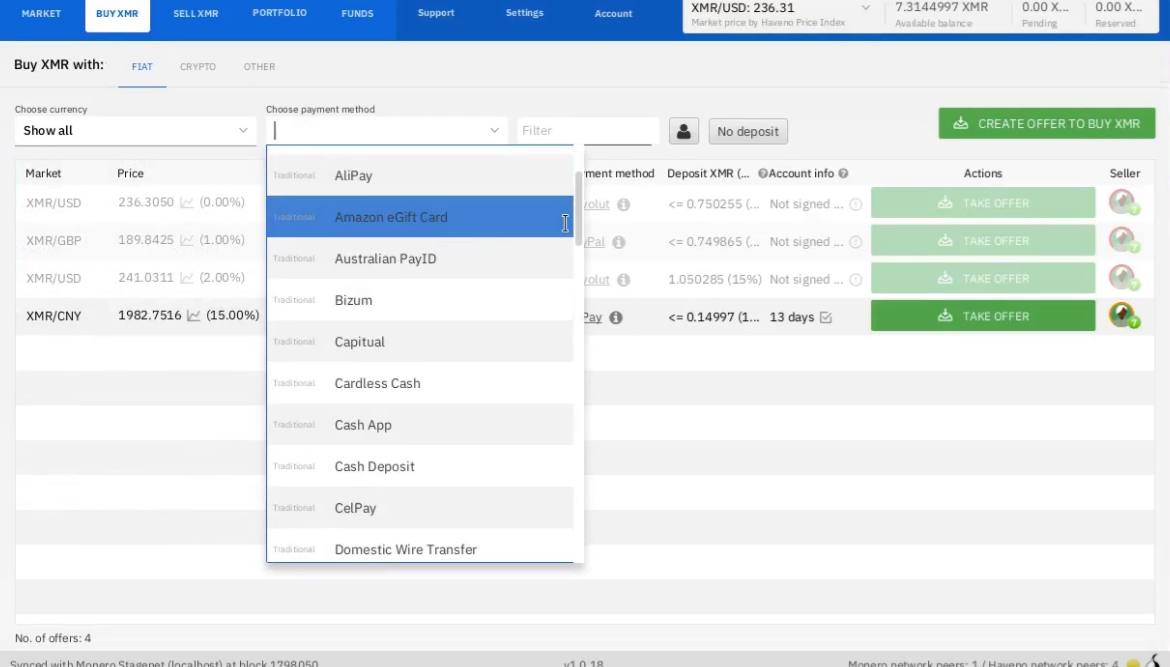
Hey bro, worth looking into Bisq and Haveno as references for exactly what you’re describing. The escrow and P2P trust layer is the missing piece, and both projects already solved that problem in open source, Bisq for BTC, and Haveno, which is a replica copy of Bisq rebuilt for XMR. The beauty is that payment methods are never hardcoded into the protocol, so whether it’s bank transfer, gift cards, or any local method someone can imagine, it just works. That directly addresses the fragmented fiat on-ramp problem.


Where BCH actually beats both of them is the primitives we have now. With covenants and CashVM being introduced to BCH, you can bake the escrow logic directly into script rather than relying on a multisig mediator, the way Bisq does on BTC. CashTokens make security deposits even cleaner — lock BCH, get an NFT claim token, and redeem it on-chain. No custodian. And with ZKP coming post-May 2026 mainnet (you can already test this on chipnet today), you can do payment proofs for fiat rails the same way ZKP2P/peer.xyz does for Venmo and PayPal receipts, but fully BCH-native.

The practical path is to fork the P2P networking, trade protocol, and UI logic from Bisq and Haveno since that’s all open source, then build the BCH-specific layer from scratch using CashScript for the covenant escrow contracts and CashTokens for the NFT deposit and redemption mechanism. Most of the hard work is already deployed or on the roadmap. Someone just needs to put it together.

2 Likes

ZKP2P / ZKAM-FMT is specifically only about creating Fiat <-> Crypto gateways.

For Crypto-Crypto gateways, you need something like BISQ, but better, because BCH has improved smart contract logic.

Anyway, to combine all of it into one “Killer App” will be massive amount of work.

Yes this is it. but the behind the scenes part of it or a pro version for liquidity providers. The average user just wants to send x amount of fiat to a wallet that is not a pain in the ass to convert to cash. They are probably willing to accept certain amount of market capture in the receiving end, as long they (the sender) is not ripped off with the exchange rate.

That’s very frustrating because if we could avoid converting BCH to the target fiat all that integration is unnecessary.

Thinking about one of the strategies Paytaca (I think is Paytaca I’m not 100% sure) is using to onboard new merchants. They guarantee the amount in Pesos of whatever payment they receive in bch for a period of time to protect the merchant against volatility.

That gives me an idea. instead of being a push system, meaning user A buys BCH and sends it to user’s B wallet and then that BCH gets turned into fiat some time later. That period of time is killing us.

If we flip the script and turn it into a pull system. the sender commits an amount of fiat, and only when the receiver is ready to cash it in fiat the user’s A fiat buys BCH. That way BCH volatility is mostly irrelevant.

I think that could be done by a trusted 3rd party “the app” with a SEPA mandate, but I’m sure you guys know how to make it with other options.

If you’re interested you can read through me talk to grok about peer.xyz implemented on bch https://x.com/i/grok/share/09b4f82d1b0f4aac851f0227783c6cb8

1 Like

Unfortunately (or: fortunately for BCH) I am seeing the ZKP2P guys completely borked it. They pivoted, seemingly from the original idea.

Right now this tech is USDC <-> Venmo only.

Laughable, this no longer resembles ZKAM-FMT.

Also the zero-knowledge proofs are completely redundant to this technology, it does not change anything [for the better] in the scheme at all.

The opportunity for a BCH company to do this “right” is still open.

Basically, if you include Zero Knowledge Proofs in the solution, you would be doing it completely wrong. And surely the performance, complexity and related technical debt would rise immensely.

ZKPs are just the latest hype and the latest buzzword, they are not a magical solution for everything, just like Quantum-Proof-Everything.
